
A part of our fellow citizens have taken a foggy path that leads neither to God, the Emperor, nor peace. They have raised their hands against our properties, our honor, and our personal safety. We will not follow that path, but we go with the law in our hands to the Emperor and the Master to ask: Is there any protection for us in this country?
Saint Peter Dabar-Bosnian
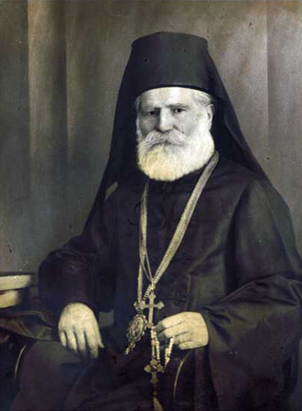
Metropolitan Peter was born on June 24, 1866, in Grahovo, under the name Jovan. He was born in 1875 as the youngest son of Mare and Duke Bogdan Zimonjić, a priest and participant in the Nevesinje rebellion. Jovan Zimonjić received his early education at his father's house. He then enrolled in the Seminary in Reljevo in 1883–84 and completed it in 1887. He continued his studies at the Orthodox Theological Faculty in Czernowitz, the only such high school in the Austro-Hungarian Monarchy. He graduated with honors in 1892 and then spent a year at the University of Vienna. Jovan took monastic vows and received the monastic name Peter. He was tonsured as a monk on September 6, 1895, in the Žitomislić Monastery, and on September 7 and 8, he was ordained a hierodeacon and a hieromonk by Metropolitan Seraphim (Perović) of Zahumlje and Herzegovina. In 1898, he was appointed a syncellus, and in 1899, Metropolitan of Dabar-Bosnia Nikole (Mandić) promoted him to proto-syncellus. In 1903, he was appointed archimandrite. From 1899 to October 1900, he was the temporary head of the Theological School in Reljevo. With his dedication, on July 20, 1901, he was appointed as a consistorial counselor of the Dabar-Bosnian Metropolitanate.
The Holy Synod of the United Serbian Orthodox Church elected Peter as Metropolitan of Dabar-Bosnia with his seat in Sarajevo, and he officially assumed that position, according to the church-legal practice at that time, by the decree of the king on November 7, 1920. In Sarajevo, he quickly became beloved among the people. He gained respect and admiration from both Croats and Muslims. During his time in the Dabar-Bosnian Metropolitanate, churches were erected and consecrated in Kaknju, Breza, Mokro near Pale, Hadžići, Turbe, and Kiseljak; church bells were installed in Rudo; a new church was built in Breza; a church tower in Bugojno; bells; and a chapel in Osijenica near Zenica. Before the war, the Temple of the Transfiguration of the Lord was built in Novo Sarajevo and was consecrated on September 8, 1940, by the Serbian Patriarch Gabriel, together with the assistance of Metropolitan Peter, Bishop of Žiča, Nikolaj, and other Serbian hierarchs.
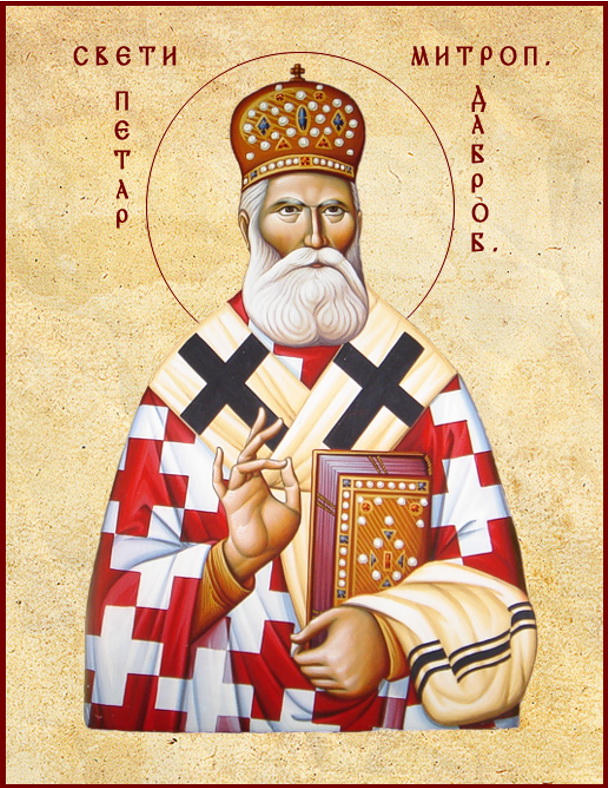
The Nazi-German attack on Yugoslavia on April 6, 1941, found Metropolitan Peter in Sarajevo. After the German bombing of Sarajevo, on Great Wednesday 1941, in the company of Archpriest Stevan Petrović, the Metropolitan temporarily sought refuge in the Monastery of the Holy Trinity near Pljevlja. According to eyewitness accounts, when he arrived at the monastery, the Metropolitan was upset and angry at Archpriest Stevan for persuading him to leave Sarajevo, saying, "It would have been better if I stayed with my people." On the second day of Easter, April 21, 1941, he returned to Sarajevo. He wanted to be with his people, regardless of the fact that the Ustashe were arresting, torturing, and killing Serbs in Sarajevo. After refusing to hold a thanksgiving service for Pavelic and to use the Latin alphabet in official correspondence, Metropolitan Peter expected to be arrested at any moment. On the afternoon of May 12, 1941, Ustashe police agents came to the Metropolitanate and took the Metropolitan to the "administration", not allowing anyone to accompany him. From the police headquarters, Metropolitan Peter was taken to the notorious Ustashe camp in Gospić. There, he was tortured and mistreated: he was taken out to the camp courtyard in rain and downpour, beaten with batons, and forced to "preach as he preached to the Serbs in Sarajevo." After torture, Peter was killed in the camp in Jasenovac and thrown into a red-hot brick oven. Even today, the exact location of the grave of Metropolitan Peter Zimonjić is unknown, as is the exact date of his death.
The Holy Synod of the Serbian Orthodox Church declared Metropolitan Peter Zimonjić a priest martyr in 1998. In the Diocese of Zahumlje and Herzegovina, churches dedicated to the priest martyr Peter are under construction in Danica near Gacko and in Vojkovići, in the Diocese of Dabar-Bosnia. In the Serbian Church, he has already been depicted as a saint in the Patriarchates of Peć, Ljubljana, and Kragujevac. The Serbian Church celebrates him on September 17.
The "Codes of Time" project was supported and implemented by the municipality of Istočno Novo Sarajevo
in cooperation and at the idea of the students of class IV3 - IT technicians,
generation 22/23, of the High School "28. Juni".